home
Updated 11/07/05
new test
ANTIQUEMACHINERY.com Machine Shop, Wood Shop, Machinery Collector's & Users information helpsite on Antique, Old, Used, Vintage, Flat Belt Drive helpsite and Network for Metalworking Tools, Woodworking tool, ,Machine trades, crafts skilled trade using Lineshaft, flat belt, Exchange of information. (Site updated 4-16-2005) -Lathe, horizontal milling, mill, boring mill, radial drill, drilling, shaper, shaper, planer, planner, gear cutting, hobbing, hob, hobber,
|
Use the links below to find the
section you want , also look down at the right main page to find ,pictures,
help& information
Build your own Antique style wood Truck Kits for kids Crafts Click here for Richard Spens RESUME & Cover Letter Click here for PAUL SPENS family genology PAUL W. SPENS family genology *My Machinery Want List Machines I'm looking for. *Why I collect and help with antique machine tools what I hope to do with my machines Machine Photo Galleries, some are mine. some belong to others *MACHINE TRADERS PAGE, buy, sell, or trade machines parts and related items for money only. *Display a problem, or a solution, find or share help, Refer people to an ANTIQUE MACHINE you are looking for, Or of one that needs to be saved. View the displayed problems & Solutions and Referrals above. Post and display your name and e-mail, network with other collectors. View the postings and Network with collectors from above. Neat Machine Related Links to Resources *Antique Restorations, Reproductions Parts, Solutions, Made/Repaired
Bruce Davidson's
WEBSITE links under CONSTRUCTION |
This website is intended to be a collector's
and user's forum in which to exchange Information and help related to
antique machine tools and related crafts and trades. The Collectors Network
focuses on antique machine shop and woodworking machinery.
My favorite, Gear cutting Machines and information:
click here How to
Make spur gears on a Metal Shaper Engineering drawings of Brown and Sharpe #13H Automatic gear cutting machine (I have one of these from 1928 in my collection) Step into the world of a
1877-1910 machinist during America's industrial glory days of expansion by
reading and internalizing their thoughts:
Machine collectors network and help.... Click here to post your name and pictures to this website's bulletin board so you can communicate with and meet other collectors. Click here to see bulletin board from above. Click here to see add review comments page. Click here to see post your name to network page. Click here to post a problem, or a solution, find or share help, Refer people to an ANTIQUE MACHINE you are looking for, Or of one that needs to be saved.
Click here
to View
the displayed problems & Solutions
from above.
Click here
to
View
Neat Machine Related website Links and
Resources
See and meet the other guys that like Antique Machine tools collectors
pages.(that I know of) Click here for The Keth Blaho of Eaton Valley Pa. Collection Click here for The Tim Jones of Mass. Collection
This is the official web site of
Antique, Used, Old, Machine Shop & Parts,
Tools, Woodshop Machinery Collector's / User's Exchange of Information &
Network. Antiques, Antique Machine shop &Woodshop Machinery & Parts, antiques ,history, historical, engine, engines, steam, steam engine, traction, traction engine, stationary engine, hit and miss, railroad, rare, model engineering, RR, autos, cars, trucks,ANTIQUEMACHINERY.com Machine Shop, Woodshop Machinery Collector's / users of Antique, Old, Used, Vintage, tools, Metalworking Flat Belt Drive Lineshaft Help site and related trades Exchange of information network. |
||||||||||||||
| RichardSpens@antiquemachinery.com this link does not work | |||||||||||||||
A
Magazine article about what I am doing with antique machine tools.
(restoring,
finding, collecting them
)
ANTIQUEMACHINERY.com Machine Shop, Wood Shop
Machinery Collector's & Users of Antique, Old, Used, Vintage, Information
Network. Metalworking Tools, Woodworking tool, Flat Belt Drive, Lineshaft, Help
site and related trades Exchange of information. (Site updated 11-26-2002)
My MENTOR T. A. Edison (no, this is not me)
Click here for pictures of some of my antique Machines
If He Builds It, Will They Come?
Richard Spens has been purchasing and rebuilding antique machine tools for nearly a decade. He is drawn to the ornate architecture and fascinated by the open design that allows you to see a machine as it operates. Of course, this interest is nothing new. "Working with machines has been a lifelong thing with me," said Spens, now a design engineer. "I started building steam engines when I was 10 years old." What he's working on now, however, is bigger than any steam engine or machine tool.
In the Township of Cohoctah Michigan, Spens is working on converting an old dairy barn into an accurate recreation of a turn-of-the-century, belt-driven gear shop. It's an outgrowth of his interest in antique machine tools and, he feels, a way to stem the tide that is costing America so many manufacturing and skilled trade jobs.
"I see America losing its industrial base and hands-on skill, said Spens. "I think it's important to keep up the interest in the young people." He is hoping that his antique gear shop will be able to do just that by introducing children to machine tools that they can see into, watch in operation, and even operate themselves. Ideally, they could create something that they could take away as a souvenir. It was an idea Spens got while visiting the Henry Ford Museum's machine shop exhibit. "People were lined up to take a turn making a little candlestick at a turret-lathe they had set up. A machinist-an old timer-would take them through the procedure, and they came away with the candlestick they made themselves. I thought it was great."
The skills of that "old timer" are another thing Spens sees falling away from Americans today. "It used to be that the people operating these machine tools had to be artists," he said. "Things were made by skilled hands. Then the technology improved and the art was taken out of making
A
Magazine article about what I am doing with antique machine tools.
(restoring,
finding, collecting them
)
ANTIQUEMACHINERY.com Machine Shop, Wood Shop Machinery Collector's & Users of Antique, Old, Used, Vintage, Information Network. Metalworking Tools, Woodworking tool, Flat Belt Drive, Lineshaft, Help site and related trades Exchange of information. (Site updated 11-26-2002)

My MENTOR T. A. Edison (no, this is not me)
Click here for pictures of some of my antique Machines
If He Builds It, Will They Come?
Richard Spens
He Builds It, Will They Come?
Richard Spens has been purchasing and rebuilding antique machine tools for nearly a decade. He is drawn to the ornate architecture and fascinated by the open design that allows you to see a machine as it operates. Of course, this interest is nothing new. "Working with machines has been a lifelong thing with me," said Spens, now a design engineer. "I started building steam engines when I was 10 years old." What he's working on now, however, is bigger than any steam engine or machine tool.
In the Township of Cohoctah Michigan, Spens is working on converting an old dairy barn into an accurate recreation of a turn-of-the-century, belt-driven gear shop. It's an outgrowth of his interest in antique machine tools and, he feels, a way to stem the tide that is costing America so many manufacturing and skilled trade jobs.
"I see America losing its industrial base and hands-on skill, said Spens. "I think it's important to keep up the interest in the young people." He is hoping that his antique gear shop will be able to do just that by introducing children to machine tools that they can see into, watch in operation, and even operate themselves. Ideally, they could create something that they could take away as a souvenir. It was an idea Spens got while visiting the Henry Ford Museum's machine shop exhibit. "People were lined up to take a turn making a little candlestick at a turret-lathe they had set up. A machinist-an old timer-would take them through the procedure, and they came away with the candlestick they made themselves. I thought it was great."
The skills of that "old timer" are another thing Spens sees falling away from Americans today. "It used to be that the people operating these machine tools had to be artists," he said. "Things were made by skilled hands. Then the technology improved and the art was taken out of making things
like a gear set." You still had to be skilled, to know what you were doing, but the process was more scientific, centered more around operating the machine than around making the gears. Spens sees this as a tragedy, and he is hoping that his antique gear shop can someday help turn that around. In their heyday, these were the machines of artists.
According to Spens, one of the jewels of his collection, and the most operational gear machine he has, is a Chase and Sloane machine built in the 1880s. A tabletop machine with its own motor, it was used to cut the tiny gears that went into the foot-powered dental drills of the day. "It has two levers for feed control-one horizontal and one vertical-and cuts one tooth at a time," explained Spens. "It was one of the most accurate gear cutters of its time. To make the drill as quiet as possible, it had to be."
Some of the other gear machines that will one day adorn his shop include another Chase and Sloane, this one with a three-spindle head that gashes, rough-cuts and finishes the tooth before the manual index moves the blank to its next position. There are also a pair of Adams gear hobbers (circa 1910) with fully open architecture and several smaller gear cutters used for watch making. Spens is also restoring an interesting pair of Gould and Eberhardt vertical hobbers, dated 1909 and 1912 respectively. These machines demonstrate the changes in machine architecture that G&E implemented during that time.
The project itself has been a long and difficult one right from the start, with humidity problems encouraging rust as well as problems with powering his shop. His long-term goal is to erect a hit-or-miss single piston gas engine to operate the belt. This, in turn, would power the belts going to the machines. However, those machines that already have motors, such as the gear machines, will not be converted in order to keep them operational. Other machines will be belt-driven to give visitors a taste of what a belt-driven factory was like. "There was a finite amount of power to go around in these shops," said Spens. "You had to work around that. Sometimes, machines would have to sit idle so that higher priority jobs could be done."
So, once he finishes his belt-driven gear shop, will it be open to the public? Yes, he answers, but at first only on a limited basis. "It'll start out as a kind of private exhibit people can visit on a one-on-one basis. My ultimate goal, however, is to make it a hands on museum to educate teens and young adults of how the machines of the past built the better life we know today.
In his words…
“Museums today seem to be straying from the need to show history both an interesting and tangible way using real Artifacts, large descriptive human interest photos, and hands on related machine movement.”
The early principals of mechanics and electrics support today’s comparably easy life. Currently there is such a focus on high technology that those students who don’t have such good grades but have a lot of other abilities are left behind in poverty. There is a need especially to provide the segment of the population that is not college bound with a skill and employment. Those Students need a place to go, and that place has traditionally been in manufacturing. I want to interest them in careers in industry; industry today requires a certain amount of college level classes, but not an advanced degree
Public use issues that go along with the creation of a museum proper are simply cost prohibitive", But almost anyone short of an inspector can become an instant friend and come over and see that things worked surprising well for what the old boys had to work with technology speaking.
If you think you can help, Spens would love to hear from you. If you have an antique machine for sale, or you'd like to donate one, please write to him at the address below. Also, if you are interested in acquiring antique machine tools, he would be happy to point you in the right direction. Write to him at:
Richard Spens
28515 W. 7-Mile Rd.
Livonia, MI 48152-35010
Call at 248- 474-2799
Second article
Nov. 12, 2002
Richard
Spens has a hobby that leads him onto the Internet, through magazines, to
auctions and into farmers’ back yards. It’s a hobby that he succeeds
at through obsessive-compulsive behavior—his joking description of his
persistent interest, and the way he uses to solve his problems at work,
because he never gives up .
He says he looks everywhere and all the time for what he wants, to the
limit of what his wallet—and his wife—can stand.
Richard
Spens collects antique machinery. About six years ago, his hobby led him to a
McDonald’s parking lot near Midland, MI, to meet a woman taking her daughter
to college in Michigan’s upper peninsula. The woman’s SUV was carrying Spens’
latest acquisitions.
One of those acquisitions was a hand-operated gear-cutting machine that may be
as many as 116 years old.
That age is based on the company name on the machine: Sloan, Chance and Co. That business was organized in 1886 as a partnership between Charles T. Sloan and George E.O. Chance. Sloan originally founded the business in the 1870s. The 1886 partnership later became Sloan and Chance Mfg. Co. All three versions of the business made small bench lathes, small bench milling machines and small gear-cutting machines.
Spens knows little else about the business and that much he learned from one of its lathe catalogs and from American Lathe Builders: 1810–1910, a history by Kenneth L. Cope.
That day at McDonald’s in 1996, Spens used 2 x 6s to slide his new acquisition from the woman’s SUV to the back of his pickup truck, along with a second antique machine and some collets and attachments. Spens’ total bill: $350 for the machines and other parts, $40 for the delivery service.
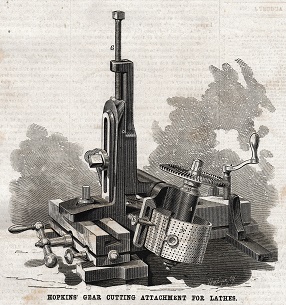
Now in his basement workshop, Spens’ hand-operated gear-cutting machine can be used to make spur, face and straight bevel gears. The gears can be brass, cast-iron or steel, can have teeth as fine as 24 DP, and can be as much as 4" in pitch diameter. Also, the teeth can be accurate to 0.002" of tooth-to-tooth error and 0.005" of total composite error on larger gears. According to Spens, the machine is more accurate when cutting smaller gears.
“For its time, that was pretty good,” he says of the machine’s accuracy, “especially on that larger size gear.”
Spens himself has cut a brass spur gear with a 0.920" outside diameter and 24 DP to a quality level that he equated with AGMA Q7.
Spens explains that the machine cuts each type of gear based on the position of its arbor. The arbor can be moved anywhere along an arc radius just below and ahead of the gear-cutting tool. If the arbor is in a horizontal position, the machine cuts spur gears. If in a vertical position or at the arc’s bottom, the machine cuts face gears. If at an angle, it cuts straight bevel gears in two or three passes.
The arbor and indexing adjustment can be finely adjusted downward to create gears of different diameters. The depth of cut can be adjusted by placing shim stock under the feed stop.
Also, the machine has a vice that can be placed anywhere along the arc. The vice has a feed adjustment that can be moved in thousandths of an inch.
Spens thinks the vice and feed adjustment were used to make racks, cutting one tooth at a time, then advancing the blank the proper distance and cutting the next tooth.
Spens has more than 40 antique machines in his collection and wants more, including other gear-making machines. Currently, he’s looking for what he terms the “elusive” 1900–1920s Gleason bevel gear planer.
He explains that the planer’s operation is very complex and quite interesting: The planer uses its single cutting tool like a shaper cutter, but it cuts gears by tracing an involute template or other tooth form template. He adds that the planer planes its tooth forms to any pressure angle on any size blank up to the machine’s capacity.
Specifically, he’s looking for the planer model that can cut blanks with outside diameters up to 24".
Given his interest, Spens’ reaction to finding that model or another antique machine that interested him, can be easily predicted: “I’d buy it, if—you know—it was affordable; and I’d probably come out and get it.”
ANTIQUE MACHINERY WANTED!!!
~ ~ ~DEAD OR ALIVE $$$
I'm trying to re-create an overhead Flatbelt lineshaft driven metal and wood shop. Help me save our machine shop heritage that built American Industry. This shop will be for show, demonstration and working. I'm looking to purchase pre-1925 Flat-belt or lineshaft driven woodworking or metalworking machines. 1'm especially looking for ornately cast or decorated machines, GEAR CUTTING MACH. a Horz. Boring Mill; Vert. Boring MIll; Vert. Slotter; 1 to 4 Spindle Automatics; Drop Hammer; Radial arm Drill. Also Brown and Sharpe or Hendy brand machines, and various grinding mach. . .....If you have heard of some I will be glad to pay 20% finders fee for information leading to the purchase of the above machine. ......Please save this request and pass my name along to someone who may have a shop, barn, garage, or yard with any of these machines for purchase or just looking at.
Also see me website in progress at
antiquemachinery.com
My Mailing address is
Richard Spens or call me at: . . 28515 W. Seven Mile Rd. (248)-474-2799 . Livonia, MI 48152-3501
Please Leave a message if I'm not there.
Back to the top